Religious Sights in Cannes — 11 of Our Favourites

Discover and book the top Cannes sights

Cathedrale Notre Dame du Puy, Grasse

1. Cathedrale Notre Dame du Puy, Grasse

Location
Grasse

The medieval church of Notre-Dame du Puy was raised to cathedral status in 1244, when the bishop transferred from Antibes to Grasse.

Its Provençal Romanesque style has been well preserved throughout the centuries. In the 17th century, an exterior staircase was built, while a chapel dedicated to the Saint Sacrament was added in 1740, in a beautiful Baroque style.

The cathedral’s strict, basic style, structure, vaults, and discreet décor reflect Lombardian and Ligurian influences. It shelters works by such masters as Rubens, Charles Nègre, a beautiful triptych by Louis Bréa, and the only religious painting by Jean-Honoré Fragonard, Le Lavement des Pieds (The Washing of the Feet).

Abbaye de Lerins (Lerins Abbey) Monastery, Ile Sainte-Honorat

2. Abbaye de Lerins Monastery (Lerins Abbey), Ile Saint-Honorat

Location
Cannes

Located on the island of Saint Honorat, the abbey is still occupied by monks. It's possible to receive a guided tour and re-charge your spiritual batteries.

The present community of monks have inhabited the island since the arrival of the first Cistercian monks from Senanque (near Avignon) in 1869.

There are many ancient chapels surrounding the monastery, plus stunning flora and fauna for you to stroll in and around whilst you discover the beauty of the site. You can visit the historic monument of the fortified monastery and discover the ancient chapels dotted around the perimeter of the island. The island itself is maintained, cultivated and ecologically preserved. 

It's also possible to participate with the monastic community and, although there are parts not accessible to the public, the church is still open. If you want to visit for longer to really recharge, enjoy the silence, and pray... there is the opportunity to stay on the island, in the hospitality of the Abbey.

Abbey of Valbonne, Valbonne

3. Abbey & Church of Valbonne, Valbonne

Founded in the 13th century by monks from the Order of Chalais, the church was built between 1199 and 1230. It features minimalist architectural lines, typical of the order which reached its peak at this moment, before its decline and disappearance in 1303.

This was a small abbey, housing a maximum of 30 monks. The simple church, now a parish church, can be visited, as well as the monastery buildings, which are very well preserved, including a sacristy, chapter house, refectory, kitchen and workshop. The beautifully minimalist cloister, where remnants of the tiled roof can still be seen, also houses the monks' dormitories with narrow windows on the upper floor.

Restored in the 1970s, the image of the church was changed during the 19th century when the Romanesque southern windows were enlarged. On the northern wall, a chapel dedicated to the White Penitents was opened in the 17th century.

The second floor of the cloister houses a museum showcasing the heritage of Valbonne. Traditional jobs and domestic life are explained here.

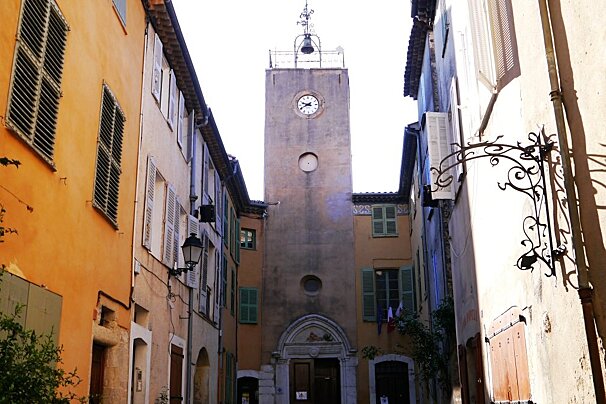
image of a bell tower in baroque style

4. Bellini Chapel

Location
Cannes

Villa Fiorentina dates back to the 19th century and was one of the first luxury villas that paved the way for aristocrats to build their holiday homes in Cannes.

The stunning Italian-baroque style residence was built by Lord Julian Goldsmith and houses a chapel which was built later by Count Vitali, in 1894, with a Baroque bell tower and clock.

Once home to the Princess of Serbia, the Cannes native Emmanuel Bellini purchased the chapel in 1953 and converted it into his art studio. It now houses exhibition of the works of art of the famous Cannes painter, colourful paintings with Fauvist and Expressionist touches.

Eglise Notre-Dame de l'Esperance in cannes

5. Eglise Notre-Dame de l'Esperance, Cannes - Le Suquet

Location
Cannes

Replacing the old chapel Sainte-Anne, the Eglise Notre-Dame de l'Esperance was completed in 1627, after more than a century of work.

Created in a late Gothic style, it stands out for its Renaissance porch and its square Romanesque bell tower separated by an archway. The adjoining square offers an exceptional view of the entire city. It has been classified as an historical monument since July 1937.

A cemetery with a sign that says allee des cyclas

6. Grand Jas Cemetery

Location
Cannes

North west from the centre of Cannes is the impressive Grand Jas Cemetery. The cemetery was built in 1866 as the town centre of Cannes kept growing thus creating a need for a bigger cemetery.

The Grand Jas was built over nine hectares of land, and today it remains a favourite place to visit as it is adorned with impressive ancient trees, pretty flowers and architecture. The English also have their own section called the 'carre anglais' which is the resting place of some English aristocracy. It is dominated by the statue of Henry Peter Brougham, 1st Baron Brougham and Vaux who played a major role in building the city.

An office just outside has leaflets listing the graves of famous people and where to find them - from Lord Brougham to Charles Fabergé. And like many Mediterranean cemeteries, it has the best view in town.

Eglise de Biot, Saint Marie Madeleine church, Biot

7. Eglise de Biot, Saint Marie Madeleine church, Biot

Location
Biot

Classified as a historic monument this 15th-century catholic church is located in the heart of the village of Biot.

The first parish church was built near the castle in the first half of the 12th-century. During the second half of the 14th-century the village was depopulated and the church destroyed in 1367. Repopulate by Genoese families in 1470, a new village church was then rebuilt, perhaps by partially reusing elements of the original one.

The side door was finished in 1506, with the main door not being completed until 1536. Side chapels were added in the second third of the 17th-century.

It is a remarkable building with many carved or painted details. It contains exceptional works of sacred art including altarpieces, such as that of the Virgin in the Rosary (16th century), attributed to Louis Brea.

The exceptional acoustics of the building make it possible to enhance concerts such as the Festival des Hours Musicales, an institution in Biot for almost 30 years and attract internationally renowned musicians.

Basilique Notre-Dame de la Victoire, Saint Raphael

8. Basilique Notre-Dame de la Victoire, Saint Raphael

Location
Saint-Raphael

This beautiful church was built as part of the plans by Mayor Felix Martin to "transform" St Raphael into a more attractive town for people to live in and tourist resort. Abbot Bernard commissioned the project to architect Pierre Aublé.

Inaugurated in 1887, it was named in honour of the famous Lepanto sea battle in 1571, when the Holy League defeated the fleet of the Ottoman Empire (and where famous Spanish writer Cervantes, author of Don Quijote, lost his hand). The Vatican elevated it to the rank of Basilica in 2004.

Created with a mixture of Byzantine style, Moorish influence and inspired by the Hagia Sophia in Istanbul, the church is a very striking building in the centre of St Raphael. Built mostly in pink sandstone from the Esterel mountain range, it covers an area on 950 square metres and at its highest point is 35 metres tall. On its façade there is a statue of the archangel Saint Raphael, protector of the town

Masses are said regularly, and the active parish surrounding this church hosts aperitifs following special Sunday celebrations.

Frejus Cathedral, Frejus

9. Fréjus Cathedral, Fréjus

Location
Frejus

Dating back to the 5th century when the baptistery was built makes it the oldest in the Provence region and one of the oldest in France. At this ancient, Merovingian style baptistery you can still see a 5th century baptismal basin for full immersion, as well as Roman columns.

The first bishop of Fréjus was Saint Leontinus of Fréjus who started the church here for the first time, hence it's referred to as Cathedrale Saint Leonce.

The cloisters were built between the 11th and 14th centuries: a series of pointed arches resting on double Corinthian columns surround the small patio. The ceilings are painted with beautiful small medieval images made in the second half of the 14th century. They depict the Virgin Mary and the infant Christ, Saint Peter, canons, priests, demons, angels, animals and fantastic creatures like a mermaid, a dragon or a centaur. There are also very interesting depictions of normal people, such as a butcher, a juggler or a knight.

Entry into the cloister is charged for, and if you're there on a Saturday you may be lucky enough to catch one of the many weddings that take place within the cathedral.

St George's Church

10. St George's Church

Location
Cannes

To the west of the town centre is the church of Saint George, built in a typically English Neo-Gothic style.

Dating back to the 19th century, the church was built in honour of the son of Queen Victoria who died in Cannes. Prince Leopold, the Duke of Albany spent much time in Cannes, which is why his brother, the Prince of Wales commissioned this church to be built in his honour.

It was founded in 1887,  and in 1974 it was sold to the city of Cannes, becoming a catholic church, although Anglican masses can still be celebrated here. Visitors can admire the pretty stained glass windows and the marble statue made in memory of the Duke of Albany.

St Michael the Archangel Russian Orthodox Church

11. St Michael the Archangel Russian Orthodox Church

Location
Cannes

Set within the affluent residential area of Quartier de la Californie, is the pretty Church of Saint Michael the Archangel. 

In 1848, Eugene-François Tripet arrived with his wife, the rich Russian heiress Alexandra Skrypitzine, to Cannes. In 1886, she ordered the construction of a small chapel inside their newly-built villa. Due to their promotion of the French Riviera among Russian aristocracy, the chapel quickly became too small and a church had to be erected.

The Russian community in Cannes donated land, money and goods, and the religious building was built in 1894 by architect Louis Nouveau based on traditional orthodox churches. The church has a distinctive roof adorned with blue domes and inside doesn't disappoint either. It is filled with pretty religious icons and gifts from several Russian artistocrats who have lived in Cannes