Sights in Cannes — 15 of Our Favourites

Discover and book the top Cannes sights

Le Moulin de Forville (musee Victor Tuby)

1. Le Moulin de Forville (Musee Victor Tuby)

Location
Cannes

Forville Mill dates back to the 14th century. Some of the original presses are still on display, as well as traditional Provencal objects.

The Boccassien Victor Tuby, sculptor, biologist and founder of the Academy of Provence, brought together a rich collection of Provencal objects in this former oil mill in the heart of Le Suquet, turning it into his sculpture workshop and lab. In 1993 it became a museum dedicated to the arts and traditions of Provence.

Open only on the first Saturday of the month from 15:00 to 18:00, the mill is now used as a museum containing lots of Provencal antiques. On display are costumes, ornaments and lots of beautiful furniture including chairs, tables and other interesting woodwork. 

Musee Bonnard, Le Cannet

2. Musee Bonnard, Le Cannet

Location
Mougins

Pierre Bonnard stayed in this beautiful Belle Epoque house in Le Cannet for over 20 years and painted many of his famous works here.

Bonnard was a founding member of the post-impressionist group Les Nabis, together with Edouard Vuillard and Maurice Denis. His works are built with bright colours that create poetic symbols based on his own personal imagery. 

The museum itself is a large complex developed around the original Belle Epoque mansion, with gardens, terraces, exhibition spaces, educational spaces and a gift shop. It has a permanent collection of Bonnard paintings, as well as changing exhibitions.

They host regular events and activities including drawing and painting workshops.

Open from 10:00 to 19:00. In July and August, they close at 20:00. Closed on Mondays.

Musee Picasso

3. Musee Picasso (Chateau Grimaldi)

The Picasso museum is housed in the Chateau Grimaldi in the centre of the town of Vallauris. The chateau was built over a Roman fort in the 16th century.

Picasso lived in Vallauris from 1948 until his death in 1955. He created many works here and was instrumental in the revival of the pottery industry and arts movement of the area. Following Picasso's success the building where he had once rented a room later became a museum dedicated to him which houses 300 of his paintings.

There are also pieces by artists Léger, Miró, Chillida, Klein, Modigliani, Picabia and Calder, among many others.

The castle, on the other hand, has its origins in the 14th century, when the Grimaldi family lived here. Turned into a town hall in 1792, it was bought by the town of Antibes in 1925. Picasso used one of its rooms as a workshop, where he made paintings and drawings, many of which he gifted to the town of Antibes.

Musee de la Mer, Ile Sainte-Marguerite

4. Musee de la Mer, Ile Sainte-Marguerite

Location
Cannes

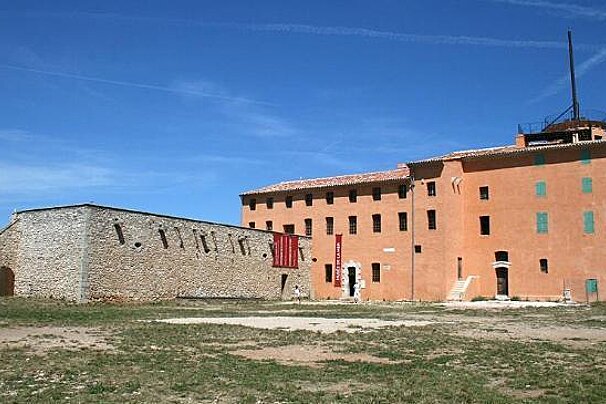
Situated within the Royal Fort on Ile Sainte-Marguerite in the Bay of Cannes, this museum is a place not only of learning but also of rich history.

This historical monument overlooks the sea and is home not only to the Musee de la Mer, but you can also visit the old state prison cell and the famous iron mask, where the mysterious prisoner was imprisoned for eleven years. In addition to this, you can see the Huguenot Memorial and murals by Jean Le Gac on the theme of the imprisoned artist.

On the first floor, you will find archaeological materials that were discovered in the sea and originate from Roman and Saracen wrecks. Tradelière Batéguier (ceramics, cargo of amphorae, glasses...) and fragments of Roman wall paintings from land excavation of Île Sainte-Marguerite are also on display. A space for temporary exhibitions opens on a wide overlooking the sea facing terrace Cannes coastline, the Southern Alps in Cap d'Antibes and the Esterel.

St Michael the Archangel Russian Orthodox Church

5. St Michael the Archangel Russian Orthodox Church

Location
Cannes

Set within the affluent residential area of Quartier de la Californie, is the pretty Church of Saint Michael the Archangel. 

In 1848, Eugene-François Tripet arrived with his wife, the rich Russian heiress Alexandra Skrypitzine, to Cannes. In 1886, she ordered the construction of a small chapel inside their newly-built villa. Due to their promotion of the French Riviera among Russian aristocracy, the chapel quickly became too small and a church had to be erected.

The Russian community in Cannes donated land, money and goods, and the religious building was built in 1894 by architect Louis Nouveau based on traditional orthodox churches. The church has a distinctive roof adorned with blue domes and inside doesn't disappoint either. It is filled with pretty religious icons and gifts from several Russian artistocrats who have lived in Cannes

La Malmaison

6. La Malmaison

Location
Cannes

La Malmaison used to be a part of the original 19th century 'grand dame' hotel - the Grand Hotel - which was demolished and then rebuilt in 1963.

Originally built in 1863 by the architects Vianey and Blondel, the Malmaison wing is the only remaining part of the hotel and was turned into a gallery in 1945.

It has since gone from strength to strength, regularly exhibiting paintings by Matisse, Picasso, Miro and Cesar. Three major exhibitions of contemporary art and photography are shown every year.

Promenade de la Croisette, Cannes

7. Promenade de la Croisette

Location
Cannes

The Promenade de la Croisette is the true heart of Cannes. Under the shade of pine and palm trees, this boardwalk stretches for over three kilometres. A great place to soak up the sun and the sea breeze while you check out the best luxury shops and hotels.

The Croisette promenade was born in the second half of the 19th century, although its current image owes more to the 1960s when it was renovated. Its name comes from the cross that once stood at the promontory between Cannes and the bay of Golfe-Juan, which attracted many pilgrims.

This wide pedestrianised walkway runs between the sandy beach and the coastal road, on which you'll find all the fancy hotels and posh boutiques. The French love to 'promenade' - you'll find romantic couples taking a stroll after a meal and chic French ladies walking their dogs with their husbands. La Croisette also has play areas for children at either end - a small funfair lies at the Palais des Festival end. You'll find many free events and activities such as music concerts here during the summer months. Plenty of bars and restaurants can be found along both sides - beach clubs on the beach, and swanky eateries on the shopping side.

Its fame comes mostly from the Palais des Festivals, where the Cannes Film Festival is hosted every year with a red carpet that reaches the boulevard. But you cannot leave Cannes without walking the Croisette and enjoying the beautiful views over the sea and Isle Sainte Marguerite. It is the best place to witness how this city came to be one of the luxury capitals of France. The street is dotted with luxury shops such as Chanel or Louis Vuitton, as well as five-star hotels like the Le Canberra Hotel, the Splendid Hotel, the iconic Carlton Hotel or the oldest one, Le Grand Hotel.

Of course, you can just take a seat on the Croisette itself - there are blue metal seats for this purpose, and you can position yourself under the palm tress to enjoy some shade on sunny days. It's fantastic for people watching, and for admiring the sports cars that glide along the boulevard.

This promenade is also the gate to some of Cannes best beaches, both public ones such as Plage Mace or Plage du Casino, and private like the Croisette Beach, or the chic Baoli Beach. The exclusive Pierre Canto Marina, located at the far end of the boardwalk, is where all the A-list stars drop anchor during the Film Festival, while the smaller Port de la Pointe Croisette, a marina for sailing boats, stands at the tip of the boulevard.

Check out our webcam at La Croisette to see what is going on live at Cannes' most famous spot.

Castre Museum, Cannes

8. Castre Museum

Location
Cannes

The Castre Museum is located on the Suquet hill, dominating the city of Cannes. From the top of the medieval tower the views across the bay and the Lerins islands are fantastic and not to be missed.

Inside the castle and the nearby chapel is a brilliant collection of paintings, art and archaeological artefacts. The Castre Museum is home to a wide collection of antiquities, particularly from the Mediterranean and the Middle East. 

The 11th century Saint Anne Chapel houses a remarkable collection of musical instruments from Asia, Africa, America and Oceania. A few rooms dedicated to 19th century Provençal paintings of Riviera landscapes open out onto the courtyard and a square tower displaying spectacular views.

It's surrounded by a beautiful Mediterranean garden with pine trees.

Hurtebize Art Gallery, Cannes

9. Hurtebize Art Gallery

Location
Cannes

This gallery has an impressive collection of post-impressionists such as Marc Chagall, Hans Hartung, Victor Vasarély, André Marfaing or Georges Mathieu, as well as a selection of contemporary artists

There is a mix of eras, schools and techniques (sculpture, painting, graphic works) in an unexpected dialogue between abstraction and figurative art, past and contemporary scene.

Art dealers from more than 30 years, they carry out a meticulous study of the artworks' provenances and strive to acquire certifications by authorised experts to guarantee irreproachable origin and authenticity.

St George's Church

10. St George's Church

Location
Cannes

To the west of the town centre is the church of Saint George, built in a typically English Neo-Gothic style.

Dating back to the 19th century, the church was built in honour of the son of Queen Victoria who died in Cannes. Prince Leopold, the Duke of Albany spent much time in Cannes, which is why his brother, the Prince of Wales commissioned this church to be built in his honour.

It was founded in 1887,  and in 1974 it was sold to the city of Cannes, becoming a catholic church, although Anglican masses can still be celebrated here. Visitors can admire the pretty stained glass windows and the marble statue made in memory of the Duke of Albany.

image of a bell tower in baroque style

11. Bellini Chapel

Location
Cannes

Villa Fiorentina dates back to the 19th century and was one of the first luxury villas that paved the way for aristocrats to build their holiday homes in Cannes.

The stunning Italian-baroque style residence was built by Lord Julian Goldsmith and houses a chapel which was built later by Count Vitali, in 1894, with a Baroque bell tower and clock.

Once home to the Princess of Serbia, the Cannes native Emmanuel Bellini purchased the chapel in 1953 and converted it into his art studio. It now houses exhibition of the works of art of the famous Cannes painter, colourful paintings with Fauvist and Expressionist touches.

Fort Royal Museum, Ile Sainte-Marguerite

12. Fort Royal Museum, Ile Sainte-Marguerite

Location
Cannes

In 1617, the Duke of Guise gave Jean de Bellon the task of building a fort intended to block sea access to Cannes. Constructed between 1624 and 1627 on the site of remains that dated back to Roman antiquity, at the time it was nothing more than a simple fortified house.

These humble origins would be enhanced a few years later by the Spanish who then occupied the islands. Only two years later in 1637 the French took back possession of the island and named the fortress Fort Royal.

At the end of the seventeenth century, the fort became a state prison and continued to grow in size. The prisoners held inside the fort include most notably: the famous, but nevertheless unidentified, Man in the Iron Mask, held for 11 years from 1687 to 1698; Six protestant pastors, imprisoned following the revocation of the Edict of Nantes, from 1689 until their deaths in 1713; Jean-Baptiste Suard, who would become the eternal secretary of the French Academy, incarcerated between 1751 and 1753; The Smala d'Abd el-Kader, from 1843; 600 Austrian prisoners, detained in 1859 after the battle of Montebello; Marshall Bazaine, the only prisoner to have escaped from the Royal fort in 1873, in what legend describes as a fantastic escape and after whom a terrace of the fort is today named.

Villa Domergue & Gardens at night Cannes

13. Villa Domergue & Gardens

Location
Cannes

Built by painter Jean-Gabrial Domergue in 1929 it was originally named Villa Fiesole. The style of the villa is highly influenced by the Italian Renaissance style and a Tuscan villa that the painter had seen near Florence.

His wife, Odette Maudrange-Domergue, a sculptor designed the Mediterranean terraced gardens, ponds and waterfalls. The antique busts and art objects were collected during the many trips the couple made together. They resided in the villa from 1932.

After the death of her husband in 1962, Odette remained in the villa and then bequeathed the property to the city of Cannes in 1973.

Open from July to late September, daily from 11:00 until 19:00.

Eglise Notre-Dame de l'Esperance in cannes

14. Eglise Notre-Dame de l'Esperance, Cannes - Le Suquet

Location
Cannes

Replacing the old chapel Sainte-Anne, the Eglise Notre-Dame de l'Esperance was completed in 1627, after more than a century of work.

Created in a late Gothic style, it stands out for its Renaissance porch and its square Romanesque bell tower separated by an archway. The adjoining square offers an exceptional view of the entire city. It has been classified as an historical monument since July 1937.

A cemetery with a sign that says allee des cyclas

15. Grand Jas Cemetery

Location
Cannes

North west from the centre of Cannes is the impressive Grand Jas Cemetery. The cemetery was built in 1866 as the town centre of Cannes kept growing thus creating a need for a bigger cemetery.

The Grand Jas was built over nine hectares of land, and today it remains a favourite place to visit as it is adorned with impressive ancient trees, pretty flowers and architecture. The English also have their own section called the 'carre anglais' which is the resting place of some English aristocracy. It is dominated by the statue of Henry Peter Brougham, 1st Baron Brougham and Vaux who played a major role in building the city.

An office just outside has leaflets listing the graves of famous people and where to find them - from Lord Brougham to Charles Fabergé. And like many Mediterranean cemeteries, it has the best view in town.